Why You Shouldn't Decide on Mole or Wart Removal Based on Appearance Alone
Hello, I am Dr. Hong Seung-ho of Lydia Women's Clinic, an OB-GYN clinic near Gangnam Station. There may be a mole that catches your eye every time you look in the mirror, or a small bump that appeared one day without warning. It might seem like nothing at first, but once it keeps drawing your attention, it can start to weigh on your mind. So you open a search engine and…

Hello, I'm Dr. Hong Seungho of Lydia Women's Clinic, an OB-GYN located near Gangnam Station.
There's that one spot you notice every time you look in the mirror —
a small bump that appeared out of nowhere one day.
It may seem like nothing,
but once it starts catching your eye, it lingers in the back of your mind.
So at some point, you've probably typed "mole or wart removal" into a search bar.
But as you start looking into it,
you may find yourself confused from the very first question:
"Wait — is this a mole or a wart?"
I see patients like this in my clinic nearly every day.
Today, I'd like to calmly walk you through the questions I hear most often —
the difference between moles and warts,
and what you should know before having either removed.
"A story from a patient in her 30s who visited recently"
Not long ago, a woman in her early 30s came to see me.
She had noticed a few small, millet-like bumps on the back of her hand.
She had read online that they looked like moles and that it was fine to leave them alone,
so she had left them untreated for nearly a year.
But at some point, similar bumps began spreading to her finger joints,
and that's when she became concerned and came in.
When I examined them under magnification,
they turned out to be viral warts — not moles.
Because she had assumed they were moles and left them alone,
they had ended up spreading.
The look on her face when she said, "If only I had known these were warts from the beginning…" has stayed with me.
This kind of situation is more common than you might think.
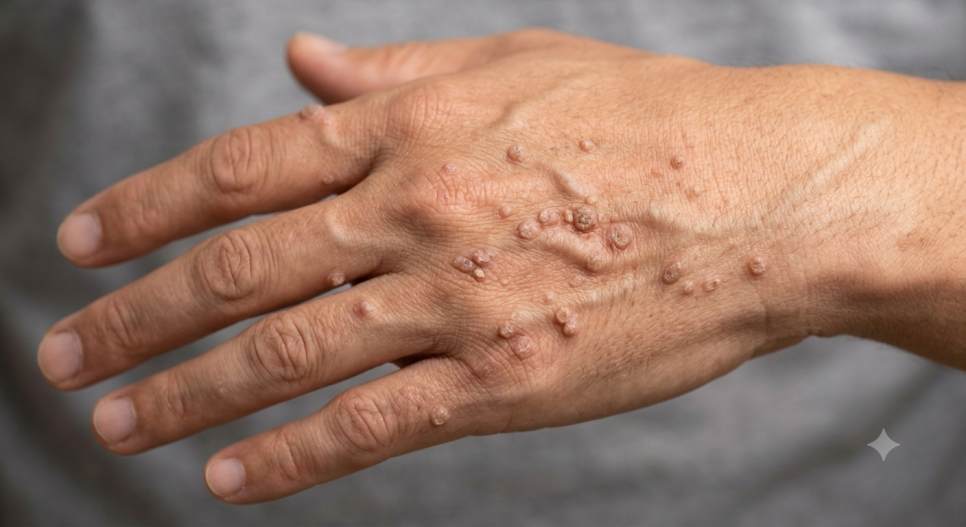
"Why do moles and warts get confused?"
A mole is a benign growth caused by a concentration of melanin pigment.
Most are brown or black,
have a consistent shape,
and once established, tend not to change significantly.
Warts, on the other hand, are an infectious condition caused by the human papillomavirus (HPV).
The two are entirely different in origin.
The challenge is that they can look similar on the surface.
In particular, pigmented warts
or moles with roughened surfaces
can be difficult to tell apart with the naked eye.
This is why patients often say, "I thought it was just a mole."
Because warts are caused by a virus,
they can spread both to other parts of your own body and to other people.
If you mistake a wart for a mole and pick at or irritate it,
it may spread to the surrounding area.
"What happens if you leave them alone?"
Moles generally remain unchanged throughout your life,
but in rare cases, their size, color, or shape may change.
In those situations, a medical evaluation is needed — not just for cosmetic reasons.
If a mole suddenly grows larger, develops irregular borders,
or bleeds, it should be examined.
With warts, the biggest concern is that they tend to spread over time.
It's not uncommon for warts on the hand to spread to the feet,
or to be transmitted to a child.
There are also cases where shaving causes them to spread across the face.
Addressing them while they are still small is a way to reduce both the number of treatments needed and the overall burden.
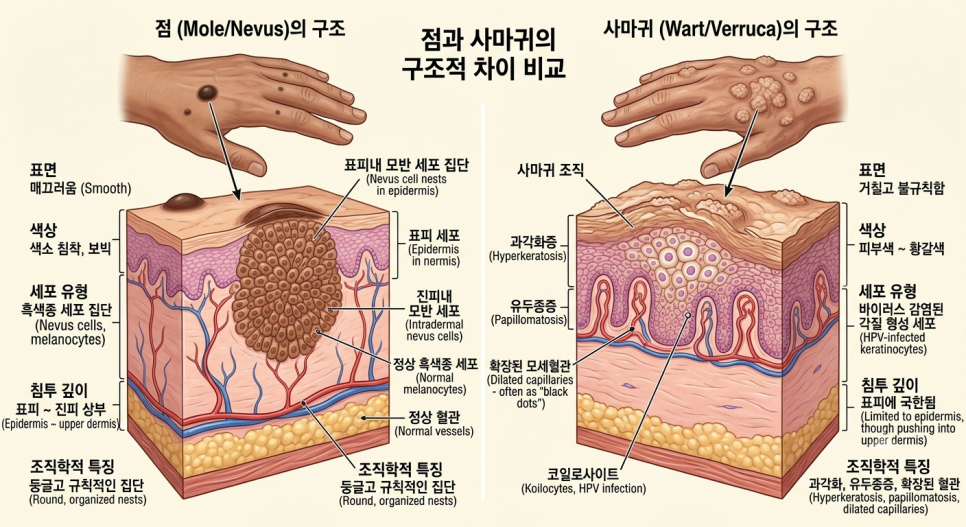
"How does removal work?"
Moles are primarily removed using a CO2 laser.
The laser precisely vaporizes the skin down to the layer containing the pigment cells.
Depth is the key factor.
Too shallow, and the mole may recur;
too deep, and scarring may result.
Finding the right balance is the physician's role.
Wart treatment varies depending on the type.
Cryotherapy, laser treatment, immunotherapy, and other approaches
are combined based on the patient's condition.
Because a virus is involved,
treatment may not be completed in a single session —
it is typically carried out over multiple visits.
Patients often ask, "Why can't it be done all at once?"
This comes down to the nature of warts.
"The process I follow during consultations"
Before any procedure, I always begin
by examining the lesion under magnification.
Determining whether it is a mole or a wart —
and if it is a wart, what type —
is necessary before a treatment plan can be established.
In cases where there is uncertainty,
I may recommend a biopsy.
Proceeding with removal based on appearance alone carries risks.
Once a diagnosis is made, I explain to the patient
the treatment plan, recovery timeline,
and the possibility of scarring honestly.
We then proceed with removal under local anesthesia,
followed by detailed aftercare instructions.
Confirming the recovery at a follow-up visit completes one full cycle of care.
"Questions I hear often"
Q. Will removing a mole always leave a scar?
It depends on the depth, location, and post-procedure care.
Shallow moles tend to leave little to no mark,
but deeper moles may leave a faint trace.
Applying sunscreen and keeping the area moisturized after the procedure
are among the most important factors in minimizing scarring.
Q. Can warts be resolved in a single treatment?
Because the virus can remain in the skin where it is not yet visible,
treatment is typically carried out multiple times at intervals of around two to three weeks.
Many patients see improvement when they stay consistent with treatment.
"Things to keep in mind at home"
After a procedure,
the most important thing is not to forcibly remove the scab.
Allowing it to fall off naturally helps minimize scarring.
Also, during the recovery period, sun exposure can cause pigmentation,
so please apply sunscreen carefully.
- Do not pick at the scab; wait for it to fall off naturally - Apply sunscreen to the treated area (SPF 30 or higher) - If you have warts, use separate towels and razors from family members
"When should you come in?"
You're welcome to visit simply for cosmetic reasons,
but if you notice any of the following changes,
I recommend getting them checked sooner rather than later:
- A mole that has suddenly grown larger or changed color - A lesion accompanied by bleeding or itching - Small bumps that are spreading rapidly
These are signs that should not be ignored.
The most common thing I hear is,
"I'm not sure if this is a mole or a wart."
Please don't hesitate — come in for a look.
A diagnosis alone is a meaningful first step.
Whether it is a mole or a wart,
what matters most in the end is an accurate diagnosis.
Deciding based on appearance alone can easily lead you in the wrong direction.
I take the time to carefully examine each patient's skin
before determining a treatment approach together.
If you have any concerns, feel free to reach out.
At Lydia Women's Clinic, we will take a careful, unhurried look.
Paying close attention even to a single small spot —
that is what I care about most.











#MoleRemoval #WartRemoval #LydiaClinic #GangnamStationOBGYN #GangnamOBGYN #MoleAndWartRemoval #ViralWart #SkinLesionDiagnosis